
PM Kisan Status Check 2026 Installment Date eKYC and Fixes
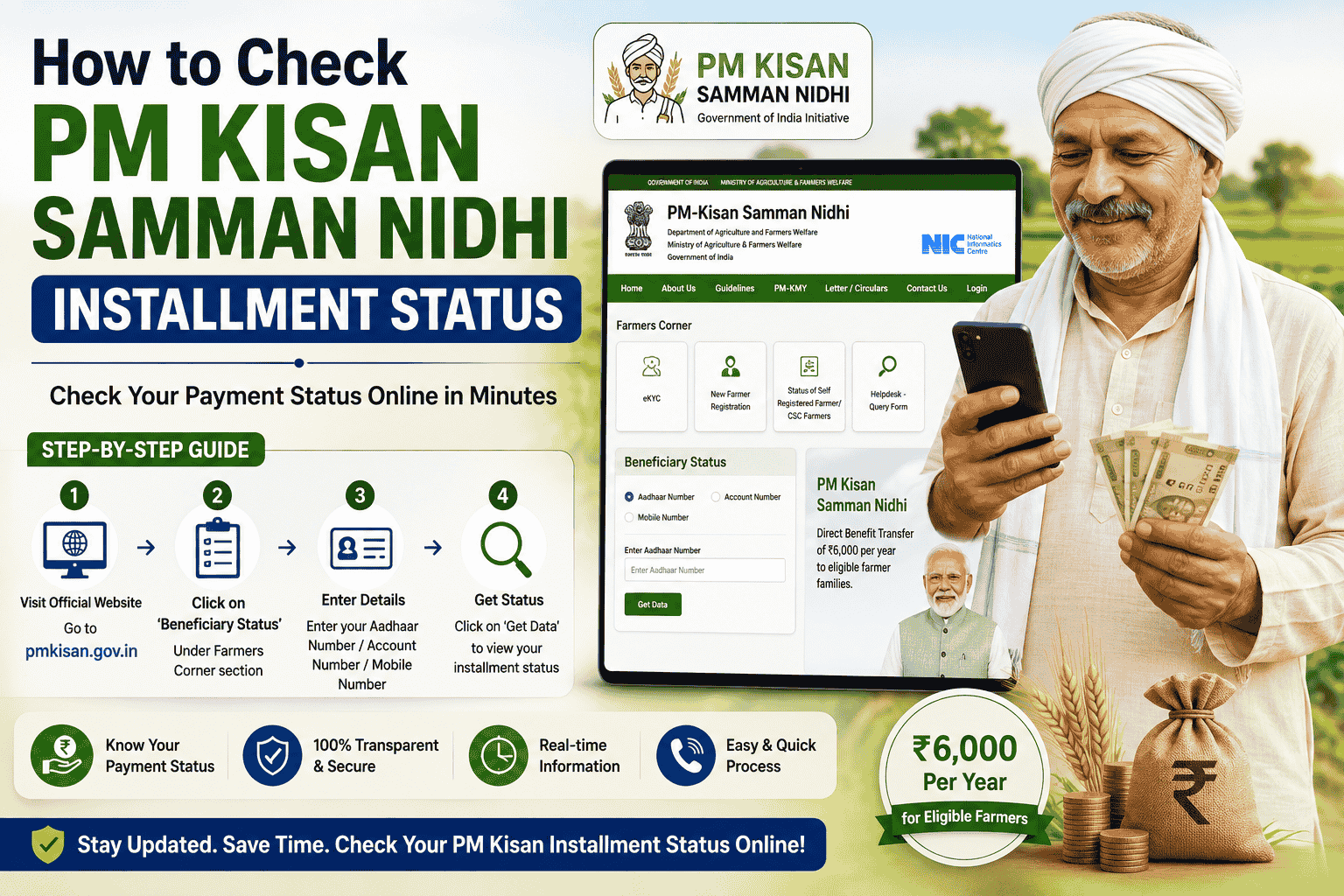
Quick answer: To check your PM Kisan installment status, visit pmkisan.gov.in, click "Know Your Status" under the Farmers Corner, and enter your registered mobile number or Aadhaar number along with an OTP. The 22nd installment (₹2,000) was released on 13 March 2026, and based on the scheme's usual four-month cycle, the 23rd installment falls due around July 2026 — check the portal directly for the confirmed release date, as it may already be out by the time you're reading this. The single most common reason payments get delayed or stuck is incomplete eKYC — check and complete this first if your payment hasn't arrived.
The Pradhan Mantri Kisan Samman Nidhi (PM-KISAN) scheme has transferred over ₹4.27 lakh crore to more than 11 crore farmer families since it launched in February 2019, making it one of the largest Direct Benefit Transfer programs in the world. Yet every installment cycle, a familiar pattern repeats: millions of farmers wait for their ₹2,000 credit, some don't receive it, and most don't know exactly why or what to do about it. This guide covers everything — how to check your status through every available method, what each status message actually means, why payments get stuck, how to fix eKYC and other common issues, and answers to the questions farmers ask most often about this scheme.
What Is PM-KISAN? A Quick Overview
PM-KISAN is a central sector scheme launched on 24 February 2019, providing financial assistance of ₹6,000 per year to eligible landholding farmer families, paid in three equal installments of ₹2,000 each. The money is transferred directly into the farmer's bank account through Direct Benefit Transfer (DBT), with no intermediaries involved. The scheme covers landholding farmers regardless of the size of their landholding, and installments are generally released roughly every four months, following a pattern of April-July, August-November, and December-March cycles.
The 22nd installment was released on 13 March 2026 by Prime Minister Narendra Modi from Guwahati, Assam, transferring over ₹18,640 crore to more than 9.32 crore farmers in that single round. Based on the standard four-month gap between installments, the 23rd installment would be expected around July 2026 — but exact release dates are announced by the government closer to the time, so the portal remains the only reliable source for the confirmed date.
Who Is Eligible for PM-KISAN?
PM-KISAN covers all landholding farmer families, but certain categories are specifically excluded from the scheme:
- Institutional landholders are not eligible.
- Families with a current or former income tax payee are excluded.
- Families with a member who is or was a government employee (central, state, or PSU) are excluded, with some exceptions for lower-level/Group D staff depending on specific rules.
- Professionals such as doctors, engineers, chartered accountants, and lawyers who are registered and practicing their profession are excluded, even if their family holds farmland.
- Pensioners drawing a monthly pension above a specified threshold are also generally excluded.
If none of these exclusions apply to your family and you hold agricultural land, you're likely eligible, and the next step is either confirming your registration status (if you've already applied) or registering fresh through the portal.
How to Check PM-KISAN Installment Status — Step by Step
There are several official ways to check your status, depending on what's most convenient for you.
Method 1: PM-KISAN Official Portal
- Go to pmkisan.gov.in.
- Under the "Farmers Corner" section on the homepage, click "Know Your Status" (sometimes shown as "Beneficiary Status").
- Enter your registered mobile number or Aadhaar number, and complete the captcha.
- Enter the OTP sent to your registered mobile number.
- Your installment history and current status will be displayed, showing whether each past installment was credited, pending, or failed.
Method 2: PM-KISAN Mobile App
The official PM-KISAN mobile app, relaunched with a Face Authentication feature, lets you check your beneficiary status directly from your phone and also complete eKYC remotely using facial recognition — useful if you don't have easy access to a computer or a nearby Common Service Centre (CSC).
Method 3: Kisan e-Mitra AI Chatbot
PM-KISAN was the first major central government scheme to integrate an AI chatbot — Kisan e-Mitra — directly into its service delivery. Available 24/7 in 11 major regional languages, it can answer questions about your application status, payment status, and eKYC requirements without needing to navigate the full website. This is a particularly useful option for farmers more comfortable typing or speaking in a regional language than navigating an English-language portal.
Method 4: Common Service Centre (CSC)
If you don't have reliable internet access or a smartphone, visiting your nearest Common Service Centre lets an operator check your status on your behalf, and also complete biometric eKYC on the spot for a small fee (typically ₹15-50).
Understanding Your Status Messages
When you check your status, you'll typically see one of a few standard messages. Here's what each one actually means:
| Status Shown | What It Means |
|---|---|
| Payment Success / Credited | The installment has been transferred to your bank account successfully. |
| FTO Generated | A Fund Transfer Order has been created and is in process — payment is on its way but not yet credited. |
| Pending | Your application or a specific verification step (often eKYC or land seeding) is still awaiting completion or approval. |
| Payment Failed / Rejected | The transfer was attempted but failed, usually due to incorrect bank details, an inactive account, or a name mismatch. |
| Aadhaar Not Linked | Your bank account is not yet seeded with your Aadhaar number, which blocks DBT transfers. |
Why Didn't I Receive My Installment? Common Reasons and Fixes
If your status shows anything other than "Payment Success," here are the most common causes, in order of how frequently they occur, along with how to fix each one.
1. Incomplete eKYC (The Most Common Reason)
eKYC is now mandatory for every PM-KISAN beneficiary, and an incomplete or expired eKYC will automatically hold your installment even if every other detail is correct. Some states also require annual re-verification, meaning an eKYC that was valid last year may need to be redone. You can complete eKYC through three methods:
- OTP-based eKYC: Instant, done directly on the portal, provided your Aadhaar-linked mobile number is active.
- Biometric eKYC at a CSC: Visit your nearest Common Service Centre for fingerprint-based verification, typically for a fee of ₹15-50.
- Face Authentication via the PM-KISAN app: Free and instant, done entirely through your phone's camera — a good option if your Aadhaar-linked mobile number isn't active or accessible.
2. Aadhaar Not Linked to Bank Account
DBT payments require your bank account to be seeded with your Aadhaar number. If this link is missing or broken, visit your bank branch to have your account re-seeded, or check via your bank's mobile app or NPCI's mapping status tool.
3. Incorrect or Outdated Bank Details
A wrong account number, IFSC code, or a name mismatch between your bank records and your PM-KISAN application can cause the transfer to fail. You can update your bank details through the "Edit Aadhaar Details" or "Update Bank Account" option on the portal, or by visiting your local Agriculture Department office.
4. Land Record Mismatch
Your land records need to be digitally seeded and verified in the government's PFMS database. If your land details haven't been updated or don't match official revenue records, contact your local Patwari or Talati (village revenue officer), who is responsible for uploading and correcting land data at the local level.
5. Inclusion Under an Exclusion Category
If your family falls under one of the excluded categories listed earlier (income tax payee, government employee, registered professional, etc.), your application may be rejected during verification. If you believe this determination is incorrect, you can raise a grievance through the portal's grievance section with supporting documentation.
How to Register for PM-KISAN (If You Haven't Already)
- Visit pmkisan.gov.in and go to the "Farmers Corner" section.
- Click "New Farmer Registration."
- The system will first check whether you're already registered under your Aadhaar number to avoid duplicate entries.
- Fill in your details — name, bank account information, IFSC code, address, and land details — accurately, since even small mismatches here can cause payment issues later.
- Submit the form. Your state or Union Territory administration will then verify and process your application.
You can also register in person at a Common Service Centre or through your local Revenue/Agriculture Department office if you prefer not to do it online.
What to Do If Your Grievance Isn't Resolved
If you've completed eKYC, confirmed your bank and land details are correct, and your installment still hasn't arrived after a reasonable period, there are a few escalation options beyond the standard portal grievance form:
- Portal grievance section: Submit a formal grievance directly on pmkisan.gov.in under the "Farmers Corner," which is tracked and typically responded to within a set timeframe.
- PM-KISAN helpline: Farmers can call the toll-free helpline number for direct assistance with status queries and grievances — the current number is listed on the official portal's homepage.
- RTI request: As a last resort for a persistently unresolved case, farmers can file a Right to Information (RTI) request with their District Agriculture Officer, specifically asking for the reason behind a missed installment, current eKYC status, and land-record linkage status. This has proven effective in some documented cases where a specific technical issue (like an expired eKYC that wasn't obvious from the portal alone) was only identified through a formal RTI response.
PM-KISAN Installment History and Disbursement Scale
Since its launch in February 2019, PM-KISAN has grown into one of the largest direct-transfer welfare programs globally. Coverage expanded rapidly in its early phase — from around 3.16 crore beneficiaries in the very first installment to a peak of roughly 10.48 crore by the 11th installment — and has remained broadly stable in that range since. As of the 22nd installment in March 2026, cumulative disbursement under the scheme has crossed ₹4.27 lakh crore, transferred to over 11 crore farmer families across the country since inception.
How to Update Your Mobile Number in PM-KISAN Records
A surprisingly common issue farmers run into isn't a missing payment at all — it's simply losing access to the mobile number originally registered with their PM-KISAN application, which then blocks OTP-based status checks and eKYC. If your registered mobile number is lost, deactivated, or no longer with you, here's how to update it:
- Through the portal: If you still have access to your Aadhaar-linked mobile number (even if it's different from the one on your PM-KISAN application), you may be able to update your contact details directly under the "Update Aadhaar Details" section.
- Through a CSC: Visit your nearest Common Service Centre with your Aadhaar card and any other requested ID proof — the operator can update your registered mobile number in the system after verification.
- Through your local Agriculture Department: For cases where online or CSC updates aren't straightforward, your local Agriculture Department or Revenue office can manually correct your contact details in the system.
It's worth doing this proactively rather than waiting until you urgently need to check a payment status — a mismatched or inactive mobile number is one of the more time-consuming issues to resolve if it comes up right when an installment is due.
State-Specific Variations Worth Knowing
While PM-KISAN is a central government scheme with uniform eligibility rules on paper, the on-ground verification process — particularly land record digitization and eKYC re-verification requirements — is implemented through state and local revenue administrations, which means practical experience can vary somewhat by state.
- Some states require annual eKYC re-verification even for previously verified beneficiaries, which catches many farmers off guard when a payment that arrived reliably in past cycles suddenly stops.
- States with more fully digitized land records tend to see fewer "land record mismatch" rejections, while states still transitioning from manual to digital land records may see more farmers stuck at this specific verification step.
- The specific local official responsible for land-record correction is typically called a Patwari in northern and central India, a Talati in parts of western India, and may go by other regional titles elsewhere — if you're unsure who to approach locally, your nearest Common Service Centre or Block Agriculture Office can point you to the right official.
If you've moved states or your farmland is registered in a different state than where you currently reside, it's worth double-checking that your PM-KISAN registration reflects the correct state's land records, since a mismatch here can also cause delays.
Other Farmer Welfare Schemes Worth Knowing About
PM-KISAN is often a farmer's entry point into India's broader ecosystem of agricultural welfare schemes, and being registered under PM-KISAN can sometimes simplify enrollment in related schemes since basic verification is already on file.
- PM Kisan Maan-Dhan Yojana: A voluntary pension scheme for small and marginal farmers, offering a monthly pension after the age of 60 in exchange for a modest monthly contribution during working years.
- Pradhan Mantri Fasal Bima Yojana (PMFBY): A crop insurance scheme protecting farmers against yield losses due to natural calamities, pests, and diseases.
- Kisan Credit Card (KCC): Provides farmers with access to short-term credit for agricultural needs at subsidized interest rates, and PM-KISAN beneficiaries are often specifically targeted for simplified KCC enrollment drives.
- Soil Health Card Scheme: Provides farmers with soil nutrient status reports and crop-wise recommendations to improve productivity and reduce input costs.
If you're already verified under PM-KISAN, it's worth checking with your local Agriculture Department whether you're eligible for any of these complementary schemes, since the core documentation requirements often overlap significantly.
Documents Required for PM-KISAN Registration
If you're registering fresh or need to correct existing records, having these documents ready in advance makes the process significantly smoother:
- Aadhaar card: Mandatory for identity verification and eKYC.
- Bank account passbook or a cancelled cheque: Needed to correctly enter your account number and IFSC code.
- Land ownership documents: Records like a khasra/khatauni number, or your state's equivalent land record document, to verify your landholding.
- Citizenship certificate or proof of residence: To confirm you qualify as an Indian farmer under the scheme's terms.
- Mobile number linked to Aadhaar: Needed for OTP verification during both registration and future status checks.
Keeping digital or photocopies of these documents on hand also speeds up any future correction requests, since many delays stem from farmers needing to track down a specific document only after a discrepancy has already been flagged.
Frequently Asked Questions
How much money do I get under PM-KISAN and how often?
Eligible farmers receive ₹6,000 per year, paid in three equal installments of ₹2,000 each, roughly every four months, directly into their bank account via DBT.
How do I check my PM-KISAN status online?
Visit pmkisan.gov.in, click "Know Your Status" under Farmers Corner, enter your registered mobile number or Aadhaar number, verify with OTP, and your full installment history and current status will be displayed.
Why is eKYC mandatory for PM-KISAN?
eKYC verifies that the registered beneficiary is a genuine, living individual and helps prevent duplicate or fraudulent claims. It's now a mandatory requirement, and an incomplete or expired eKYC will automatically hold your installment regardless of whether your other details are correct.
Can I complete PM-KISAN eKYC without visiting a CSC?
Yes — OTP-based eKYC can be completed instantly on the portal if your Aadhaar-linked mobile number is active, and Face Authentication through the PM-KISAN mobile app offers a free, instant alternative that doesn't require an active mobile number at all.
What does "FTO Generated" mean in my PM-KISAN status?
FTO stands for Fund Transfer Order — it means your payment has been approved and is in process, but hasn't been credited to your account yet. This typically resolves within a few days.
Who is not eligible for PM-KISAN?
Institutional landholders, families with a current or former income tax payee, families with a government employee (central, state, or PSU, with some exceptions), registered professionals like doctors and engineers, and pensioners above a certain monthly pension threshold are generally excluded from the scheme.
When is the next PM-KISAN installment expected?
Based on the scheme's typical four-month disbursement cycle and the 22nd installment being released on 13 March 2026, the 23rd installment would be expected around July 2026 — check pmkisan.gov.in directly for the officially confirmed date, since it may already have been released by the time you're checking.
Can I update my bank account details after registering for PM-KISAN?
Yes — you can update your bank account and other details through the "Edit Aadhaar Details" or "Update Bank Account" options on the PM-KISAN portal, or by visiting your local Agriculture Department office if you're unable to do it online.
What should I do if my land record doesn't match on the portal?
Contact your local Patwari or Talati (village revenue officer), who is responsible for updating and correcting land record data in the government's PFMS database that PM-KISAN relies on for verification.
Is there a helpline number for PM-KISAN complaints?
Yes — a toll-free PM-KISAN helpline number is listed on the official pmkisan.gov.in homepage for status queries and grievances. You can also use the Kisan e-Mitra AI chatbot on the portal for 24/7 assistance in 11 regional languages.
What documents do I need to register for PM-KISAN?
You'll need your Aadhaar card, bank account passbook or a cancelled cheque, land ownership documents (such as khasra/khatauni records), and a mobile number linked to your Aadhaar for OTP verification.
Can tenant farmers or sharecroppers apply for PM-KISAN?
PM-KISAN is generally targeted at landholding farmer families with documented land ownership, so tenant farmers and sharecroppers without land records in their own name typically don't qualify under the current scheme structure. Rules can vary by interpretation at the state level, so it's worth confirming directly with your local Agriculture Department if this applies to you.
Disclaimer: This article is for general informational purposes only. PM-KISAN scheme rules, eligibility criteria, installment dates, and portal processes are set and updated by the Government of India and can change. Always verify current details directly on the official portal, pmkisan.gov.in, or with your local Agriculture Department before taking any action based on this guide.
Last updated: 12 August 2026.
By : ravi
By : ravi
By : ravi
By : ravi
By : ravi
By : ravi
By : ravi
By : ravi
By : ravi
By : ravi